Wednesday, 28 October 2009

Singapore - Crossroads of the East 1938

Friday, 23 October 2009

“Led Zeppelin II” Turns 40

10/22/09, Rolling Stone Mag

Forty years ago today, Led Zeppelin released Led Zeppelin II just nine months after unleashing their historic debut. Produced by guitarist Jimmy Page, II laid the groundwork for heavy metal with its classic “Whole Lotta Love” and firmly established Zeppelin as one of the loudest and greatest bands in rock at the time. II also boasts Robert Plant’s unparalleled vocal prowess on hits like “Ramble On” and “What Is and What Should Never Be” and John Bonham’s still-unmatched drum solo on “Moby Dick.”


CAN YOU GUESS WHAT THIS IS?


It's a hard disk in 1956...

HDD with 5 MB storage.

In September 1956 IBM launched the 305 RAMAC,
 

 The first computer with a hard disk drive (HDD).  

The HDD weighed over a ton and stored 5 MB of data.

Start appreciating your 4 GB memory stick!


Friday, 2 October 2009

Malaysia - KL Rocks and Sarawak Swings!


There are some fellows in Sarawak, Malaysia that would love to see the gleaming skyscrapers in the country's capital, Kuala Lumpur. I'm sure they'd particularly enjoy the PETRONAS Twin Towers, the tallest twin structures in the world. In fact they'd probably be so taken with the buildings that they'd want to climb all over them! But it'll never happen because these fellows are in fact orangutans and they're quite content with their own version of skyscrapers---the treetop canopies in which they live.

Most visits to exotic Malaysia begin in Kuala Lumpur because that's where international flights arrive. KL, as the city is nicknamed, is a place of contrasts and first-time visitors will in all likelihood be surprised by the city's modernity. An efficient express train whisks travelers from the airport to downtown KL in about twenty minutes, and then the real fun begins! KL is vast but if you pick a hotel in the part of the city that's within sight of the twin towers you'll have plenty to explore in that immediate area and you'll get a good idea of what Malaysia is all about. 
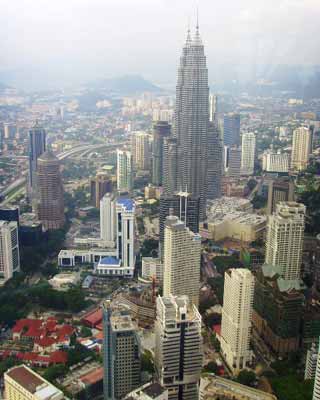
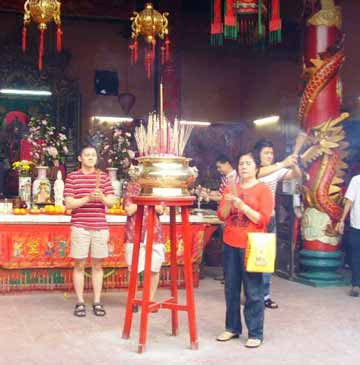
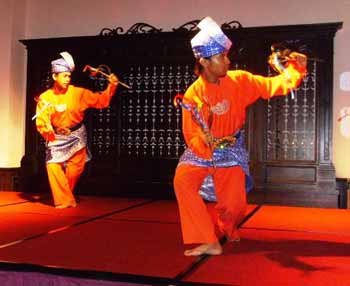
The main ethnic groups in Malaysia are Malay, Chinese and Indian and you can mingle with all these vibrant cultures over the course of a day's adventure. KL's streets are very safe and English is widely spoken so there's no reason not to take a stroll to see Indian temples decorated with ornate sculptures outside and filled with sensual incense smoke inside or look for bargains in busy Chinatown. Street food is safe here too and cool fruit drinks are always on offer and there's a local pastry called a Malaysian pancake that you can buy from street vendors---it's peanut-buttery and absolutely delicious. A KL must-do is a visit to the "sky bridge" on the 41st floor of the PETRONAS Towers where you can take in an amazing view of the city; another panoramic view can be had from the observation platform at the nearby Menara Alor Star communications tower, commonly referred to as the KL Tower. The area right around the PETRONAS Towers is called the Kuala Lumpur City Center, or KLCC, and this is where you'll find lots of upscale shopping including at the always-packed six-level shopping mall called Suria KLCC. This is a great place for tourists but it's also where the locals come to shop, dine and see and be seen. Music lovers will find lots of places to buy CDs in the giant shopping center including at one of the few Tower Records stores still in existence. Malaysia has its own music industry; EMI, Warner Bros. and all the other big companies manufacture here so you can buy locally-made copies of CDs by international acts---a CD from your favorite band that's made in Malaysia makes for a pretty cool souvenir. There's also a thriving rock and pop music scene in Malaysia and you'll find plenty of homegrown music represented on CD; grunge act Search, metal band Mau, proggy hard rock group Amuk and mellow alt-rockers Flop Poppy are just a few of the Malaysian acts signed to major labels. A very wide selection of traditional Malaysian music is available on CD too. To see a live performance of traditional Malaysian music and dance head to Saloma Bistro, right next door to the Malaysia Tourism Centre and within sight of the twin towers. Saloma presents a wonderful cultural program featuring dancers in colorful traditional costumes and the show happens while you're being served a bountiful Malaysian supper. The exotic sights, sounds and tastes you'll experience at Saloma are a very good representation of the treats you'll find everyday throughout Malaysia. Now you know that Kuala Lumpur really rocks but wait until you see how Sarawak swings!
Malaysia is geographically separated into two pieces; Kuala Lumpur is on "peninsular Malaysia," the giant thumb of land that extends down from Thailand and culminates at Singapore while part of the country lies across the South China Sea on the island of Borneo. That's where the Malaysian state of Sarawak (pronounced Sara-wah) is and also the place to find the treetop-swinging "wild men of Borneo." Sarawak is everything you'd expect from such a fabled place as Borneo; the world's largest rainforest is here and it's filled with a cast of critters that include gibbons, macaques, deer, and plenty of unusual insects like giant beetles and foot-long millipedes. But people come from the world over to see one of the rarest species of all; the orangutan! 
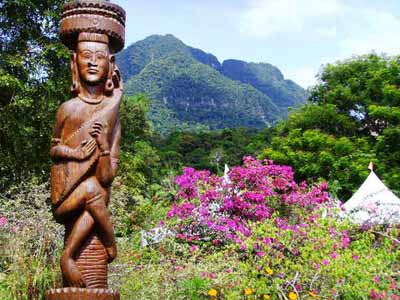

Sarawak-Cultural-Centre
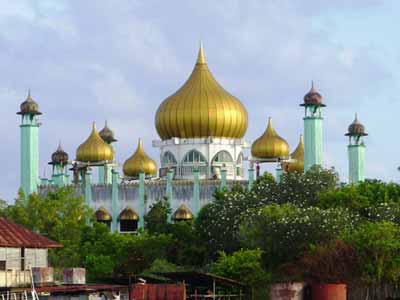

Kuching

The seaside city of Kuching is a good place to headquarter while you're in Sarawak and you can book tours to the outlying areas from here. Your best bet at seeing orangutans is with a visit to the Semenggoh Wildlife Rehabilitation Centre; part of what they do there is to care for injured and sickly orangutans. You won't see those, but you will see a bunch of others at either of two daily feeding times when the center puts out a supply of bananas, coconuts, and the like for the local orangutan population. And they know when its time to eat! Special platforms are arranged in the trees as are numerous ropes and it is quite something to see whole families of orangutans come swinging in for a meal. Usually the big daddy of them all, the group's patriarch, will sit off to himself and quietly feast while the youngsters leap and dance around and act like clowns on the ropes. When you see a mother orangutan cuddle her infant it is a reminder that these animals are indeed our not-so-distant relatives. While there are limitations on how close you can get to the orangutans you can definitely get close enough to get good pictures and for sure a trip to Semenggoh provides a memory that will last a lifetime. 
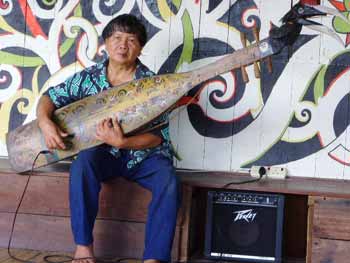

Playing-the-sape


Another fun thing to do in Sarawak is to visit the Sarawak Cultural Village that's about a forty-minute drive from Kuching. Here you'll find an extensive re-creation of a traditional Sarawakian village where you can explore "long houses" and witness various aspects of daily life like grain being ground for bread, fabrics being woven and utensils being made. You can try your hand (or should I say lungs) at using a blow-gun and if you're a musician you'll thoroughly enjoy the sape-playing demonstration. If you think you can reel off a few Hendrix riffs on the electrified string instrument just ask and they'll let you try. Plan on spending a full afternoon at the Sarawak Cultural Village---there is so much to do here that you get a "passport" upon entry that you're supposed to have stamped at every activity so you can make sure not to miss anything.

Malaysia Airlines has direct flights from Los Angeles to friendly and beautiful Malaysia. For more information go to www.tourismmalaysia.gov.my


Monday, 28 September 2009

Brigitte Bardot turns 75


Brigitte Bardot, actress, model, songwriter and activist, will be honored for the first time in France for her body of work by an exhibit of photos in Paris’ Espace Landowski. Bardot who turns 75 September 28 will not attend nor been seen in public in connection with the celebration. Stricken with arthritis, Bardot now walks with crutches and remains reclusive.

Born September 28, 1943 in Paris as Brigitte Anne-Marie Bardot, she was first featured on the cover of Elle at age 15. She debuted in her first film- Crazy for Love, a comedy, in 1952. She also played bit parts in Helen of Troy (1954), Doctor at Sea (1955).


In 1955 Bardot appeared in And God Created Woman, directed by her then husband Roger Vadim. Her explosive sexuality and carefree appearance quickly made her a lightning rod for feminism. Bardot’s name became a household word, the embodiment of a sexual revolution and a free spirit. 

 Other films in which Bardot appeared include: The Invitation to the Castle, Une Parisienne, Act of Love, Babette Goes to War and, Contempt. 

Bardot has been featured in Elle and countless other magazines covers, including Playboy in the U.S as a celebration of her 40th birthday.

 Married four times Bardot has a son from her second marriage with Jacques Charrier. Her son Nicolas-Jacques was raised by the Charrier family and Nicolas had little contact with his mother until adulthood.

Activism and controversy are not unfamiliar to Bardot. On her 40th birthday Bardot announced her retirement. Having completed over 50 films and countless recordings, Bardot would now focus her attention and fame for the promotion of animal rights. The Brigitte Bardot Foundation for the Protection and Welfare of Animals was founded in 1986. She was outspoken with the Canadian government regarding seal hunting and, most recently donated $140,000.00 for a sterilization project in Bucharest, a city with an estimated 300,000 stray dogs. 

In her retirement Bardot never shied away from politics either. She has been arrested and convicted 5 times on charges of inciting racial hatred for the expression of what she perceived as the uncontrolled Islamicizaton of France and a border policy allowing huge numbers of immigrants into her beloved France. In 1997 Bardot was fined for comments published in the newspaper Le Figaro. Though she had long since retired from her film career, Bardot remained controversial and in the spotlight through political expression and activism.

  Though not seen in public in a very long time one can view Bardot, chronicled in more than 2,000 photos, now through the end of January 2010. The journalistic display at Espace Landowski is located in Paris at 28, ave. Andre Morizet Boulogne-Billancourt just outside the city.


Friday, 18 September 2009

Russian-Bar Acrobatic

Wednesday, 9 September 2009

Newly Remastered Beatles Albums out on 09/09/09

New versions box set includes 14 classic albums, like Help!, Revolver, Abbey Road and Sgt Pepper's Lonely Hearts Club Band

The Beatles album compilation

(Sunday Times)

It’s a little bit embarrassing, frankly. To be faced with the task of describing the music of the most relentlessly original band of all time, and to realise that what you really want to say is the lamest of clichés. Oh well, here goes anyway. Listening to the newly remastered Beatles albums is like hearing the songs for the very first time all over again.

As well-trod as that line might be, I mean it. Time and again, on album after album, I felt as if I were listening to music I’d never heard before. I expected these remasters, out on Wednesday, to be a serious improvement on the 1987 CDs, which were flat and lifeless, and a travesty of the original albums; I expected to be thinking things like: “Well, they’ve really brought some crispness to the hi-hat on this one.” What I didn’t expect was to be blown away by the music all over again.

What makes the new versions so much better? Crucially, the technology that transfers analogue sound into the digital domain is significantly better than it was 20 years ago, so before the remastering engineers started tweaking anything, they had already got the sound back closer to the original masters than before. Then they used denoising technology and overall limiting. Importantly, the engineers avoided today’s trend to limit the music heavily (limiting squashes the dynamics of music, making the quieter bits seem louder, creating a more even sound, which has more impact on the radio) in favour of a subtle treatment that adds oomph but retains the original dynamics.

I resisted the invitation to go and listen to the new versions in Abbey Road studios, because what wouldn’t sound good pumping out of those huge monitors? I listened to the albums on a system that was neither new nor expensive. And yet the experience was amazing. Hearing the new versions turned these tracks back from cultural landmarks into songs, and turned the band back from icons into four musicians bashing away at instruments.

You can hear the three separate voices coming together to form those early harmonies; you can distinguish the building blocks of Strawberry Fields Forever; the noise in A Day in the Life isn’t a noise anymore, it’s an orchestra of individual instruments all making their own way to the climax. Oh, that’s how they did it. And when John Lennon sings I Am the Walrus, he has never been so clearly, thrillingly right there in the room with you. Those few minutes alone make it clear this remastering project is not about the technology in the studio; it’s about the humanity of the band. So even if you know the Beatles’ music inside out, yes, you should seriously consider investing in as many of these remastered albums as you can afford.

If you don’t know the Beatles’ music inside out, this is the perfect moment to find out what all the fuss is about. And if you’re one of the many millions who own the 1 compilation, don’t go thinking, “Oh, I must have all the best tracks already”, because the Beatles albums don’t adhere to today’s two-singles-plus-filler formula; indeed, many of them didn’t contain any singles at all; so even if you own 1 and have played the hits to death, there’s still a whole other world to explore.

The box set of The Beatles costs £169.99. Albums can be bought separately for £10.99 each

Please Please Me (Mar 1963)

The Beatles’ debut reveals a band that ? thanks to countless hours on stage in Liverpool and Hamburg — are already light years ahead of the pack. The visceral energy of opening track I Saw Her Standing There and album closer Twist and Shout haven’t dimmed — and explain exactly why this album acted as a wake-up call to the nation’s youth.

With the Beatles (Nov 1963)

With Beatlemania already established, the band’s second album opened with a brilliant salvo: It Won’t Be Long, All I’ve Got to Do and All My Loving (the song with which the band announced themselves to America on their first Ed Sullivan show performance). As with Please Please Me, the album mixes Beatles originals with covers of their favourite R&B songs, notably Please Mr Postman and Money.

A Hard Day’s Night (July 1964)

The film A Hard Day’s Night captures Beatlemania at its height; and the album of the same name acts as a semi-soundtrack, containing the seven songs featured in the film, plus six others. Despite their hectic schedule, the band eschew cover versions, with everything written by Lennon and McCartney (at this stage, still genuinely collaborating on their songs). The band’s early trademark harmonica is gradually being eased out, replaced by the jangle of George Harrison’s new Rickenbacker guitar, which inspired a generation of American bands. With the mellow Things We Said Today, the raucous You Can’t Do That and the irresistible Can’t Buy Me Love, this is the high point of the early Beatles sound.

Beatles for Sale (Dec 1964)

The sound of the Beatles treading water. The strain of four albums, a movie and countless tours in the space of two years finally shows, as the songwriting quality dips. It’s not a bad album, but by the Beatles’ high standards it’s unremarkable (with the honourable exception of Eight Days a Week and a cover of Chuck Berry’s Rock and Roll Music). With hindsight, we realise that the band were merely taking a deep breath before embarking on the most remarkable run of albums in music history.

Help! (Aug 1965)

A transitional album that marks both the last hurrah of the Beatles as an uncomplicated family-friendly pop group (The Night Before, Another Girl, Yesterday) and also the first stirrings of the revolution to come — in the lyrics of Help!, the vocal performance of You’ve Got to Hide Your Love Away, the guitar sound on I Need You and It’s Only Love, and the drumming on Ticket to Ride — Ringo Starr, with two thumps on his tom-tom drawing the line that connects the moptops of She Loves You (back in 1963) with the visionaries of Tomorrow Never Knows (to come in 1966).

Rubber Soul (Dec 1965)

The distinctive cover, on which the band’s faces are stretched out of shape, is entirely apt, because this is where they really begin to reshape music. In parallel with Bob Dylan and Brian Wilson, they took pop music and stretched all its boundaries, pushing lyrics (Nowhere Man) and melody (If I Needed Someone) into new territories. Even more remarkably, they did this while remaining the most popular band in the world. On Norwegian Wood and In My Life you can virtually hear a generation growing up.

Revolver (Aug 1966)

This is the template for all modern guitar bands. You simply can’t do it better than this. Amazingly, the album’s astonishing closing track, Tomorrow Never Knows, was the first thing they recorded, establishing a palette of backwards guitar, distorted vocals and distinctly un-pop rhythms that complemented a new seriousness in the lyrics (“I know what it’s like to be dead”). The distinction between Lennon’s angst (She Said She Said, I’m Only Sleeping) and McCartney’s good-time pop (Yellow Submarine, Got to Get You into My Life) is more marked than ever, but the conflicts and contrasts only add to the band’s brilliance.

Sgt Pepper’s Lonely Hearts Club Band (June 1967)

The album that invented the modern practice of “using the studio as an instrument”; virtually everything was either recorded or treated in an unusual way. This was the start of something entirely new, and thanks to the remasterers’ art, it all sounds entirely new again: the swirling chorus of Lucy in the Sky with Diamonds, Lennon’s precise phrasing on Being for the Benefit of Mr Kite, the remarkably sleazy brass on Good Morning Good Morning. I’ve known for decades — in theory — that the transition from Lennon’s section of A Day in the Life to McCartney’s section is something really special. Now it actually is.

Magical Mystery Tour (Dec 1967)

The original EP containing the songs from the TV film is — I Am the Walrus aside — not the band’s finest hour; but the extended album also ropes in Strawberry Fields Forever, Penny Lane and All You Need Is Love, making this a far more important document of “summer of love” Beatles.

The Beatles (Nov 1968)

One of the real revelations of the remastering process, as the band’s rockier side — Helter Skelter, Birthday, Yer Blues — hits you like a series of punches to the gut. The less-is-more approach to limiting pays dividends as the extraordinary dynamic shifts of the album (Glass Onion to Ob-La-Di, Ob-La-Da; While My Guitar Gently Weeps to Happiness Is a Warm Gun) are retained and even heightened. On Everybody’s Got Something to Hide Except Me and My Monkey, the combination of Lennon’s vocal and McCartney’s bass will leave you physically exhausted.

Yellow Submarine (Jan 1969)

The least essential of all the Beatles albums; but if you have a soft spot for It’s All Too Much or Hey Bulldog, you’ll want to hear the added power they have here.

Abbey Road (Sept 1969)

To get a handle on what the remastering process has achieved, all you need to do is listen to the first few seconds of Come Together, as McCartney and Starr create that distinctive thump-and-shimmer rhythm. The structure of Something — delicate touches in the verses, another brilliant McCartney-and-Starr combination in the middle eight — is fully revealed. The medley that closes the album is one of the band’s greatest studio achievements, and you can almost feel the remasterers’ joy at the gorgeous textures they reveal as Polythene Pam segues into She Came in Through the Bathroom Window.

Let It Be (May 1970)

Hopefully, one of the benefits of the remastering process will be the rehabilitation of Let It Be. Some people criticise it for lacking the studio finesse of the band’s other albums; others criticise the studio finesse that was added (by Phil Spector). But heard here — with greater clarity in the wah-wah guitar on Across the Universe, the choir on The Long and Winding Road, and the soaring guitar solo on the title track — it reveals itself to be an album full of wonderful moments: not least when the noodling stops and Get Back chugs defiantly into life.

Past Masters

One of those albums that collects together all a band’s nonalbum singles and some rarities. In most cases these things are “for completists only”, but because the Beatles kept so many of their great singles off their albums, this is actually a wonderful compilation that takes you from She Loves You and I Want to Hold Your Hand, through Day Tripper and Paperback Writer up to Hey Jude and The Ballad of John and Yoko. It’s not a Greatest Hits, but it’s full of great hits.


Sunday, 6 September 2009

Coal Country Trailer

Charlie Chaplin

Charlie Chaplin - The Lion's Cage

♪ Smile - Charlie Chaplin

Monday, 31 August 2009

Stevie Ray Vaughan - Tin Pan Alley (Montreux) part 1

Tuesday, 25 August 2009

Robert Plant-I've Got My Eyes On You

I'm A Woman!!

Monday, 24 August 2009

George and Ringo, w/Eric Clapton, Jeff Lynne, Elton John....

Wednesday, 12 August 2009

Christie - Yellow River

CLIVE DUNN GRANDAD

Tuesday, 11 August 2009

Woodstock: A moment of muddy grace


NEW YORK, Aug 10 — Baby boomers won’t let go of the Woodstock Festival. Why should we? It’s one of the few defining events of the late 1960s that had a clear happy ending.

On Aug. 15 to 17, 1969, hundreds of thousands of people, me among them, gathered in a lovely natural amphitheatre in Bethel (not Woodstock), New York. We listened to some of the best rock musicians of the era, enjoyed other legal and illegal pleasures, endured rain and mud and exhaustion and hunger pangs, felt like a giant community and dispersed, all without catastrophe.

A year after the riots at the Democratic convention in Chicago, expectations about large gatherings of young people were so low that this was considered a surprise. Although the festival didn’t go exactly as planned, it was, as advertised, three days of peace and music. That made Woodstock an idyll, particularly in retrospect, even though it was declared a state disaster area at the time.

“Not withstanding their personality, their dress and their ideas, they were and they are the most courteous, considerate and well-behaved group of kids I have ever been in contact with in my 24 years of police work,” Lou Yank, the chief of police in nearby Monticello, told The New York Times.

Yet for all the benign memories, Woodstock also set in motion other, more crass impulses. While its immediate aftermath was amazement and relief, the festival’s full legacy had as much to do with excess as with idealism.

As the decades roll by, the festival seems more than ever like a fluke: a moment of muddy, disheveled, incredulous grace.

Jimi Hendrix who mesmerised people 40 years back at Woodstock. - Reuters pic

It was as much an endpoint as a beginning, a holiday of naïveté and dumb luck before the realities of capitalism resumed. Woodstock’s young, left-of-center crowd — nice kids, including students, artists, workers and politicos, as well as full-fledged LSD-popping hippies — was quickly recognised as a potential army of consumers that mainstream merchants would not underestimate again. There was more to sell them than rolling papers and LPs.

With the 40th anniversary of Woodstock looming — so soon? — the commemorative machinery is clanking into place, and the nostalgia is strong. There’s a Woodstock Festival museum now at the Bethel Woods Center for the Arts and a recently built concert hall at what was the concert site, Max Yasgur’s farm (though the original Woodstock hillside has been left undeveloped).

A new, much expanded anthology of music recorded at the 1969 festival has been issued: the six-CD “Woodstock 40 Years On: Back to Yasgur’s Farm” (Rhino). Complete Woodstock performances bySly and the Family Stone, Santana, Janis Joplin and others have been released by Sony Legacy.

Cable and public television channels have their Woodstock specials scheduled, and there’s yet another batch of commemorative books, including “The Road to Woodstock” (Ecco) by the festival’s instigator, Michael Lang, which includes tidbits like how much the bands were paid. “Taking Woodstock”, a comedy directed by Ang Lee, is due for release this month.

A summer package tour, Heroes of Woodstock, features musicians who appeared at Woodstock — including Jefferson Starship (playing Jefferson Airplane songs), Levon Helm from the Band, Tom Constanten from the Grateful Dead, Ten Years After, Canned Heat and Country Joe McDonald. It arrives at Bethel Woods precisely on Aug. 15.

Unlike previous anniversaries in 1994 and 1999, however, there’s no big festival this year bearing the Woodstock name — reflecting, perhaps, the dismal memories of Woodstock ’99 in Rome, New York, where a hot, pent-up audience, angry at high vendor prices, set fires and looted and vandalized the site.

While the original Woodstock showed how much discomfort an audience would put up with for the sake of sharing an event — something promoters were happy to learn — Woodstock ’99 breached the limit of fan exploitation.

Still strumming along, Neil Young. - Reuters pic

Yet the original Woodstock still has a rosy glow. It was finite and all smiles — far different from the Vietnam War, the racial tensions and the much-discussed generation gap of the same era. Woodstock became free in both senses of the word: free as in liberated (from drug laws and dress codes) and free as in gratis, not collecting tickets and handing out, as Wavy Gravy said, “breakfast in bed for 400,000.”

A cynic might see the festival as a prime example of how coddled the baby boomers were in an economy of abundance. The Woodstock crowd, which arrived with more drugs than camping supplies, got itself a free concert, and when the people responsible could no longer handle the logistics, the government bailed them out. Some people took it upon themselves to help others; many just freeloaded.

Still, Woodstock gave virtually everyone involved — ticketholders, gate crashers, musicians, doctors, the police — a sense of shared humanity and cooperation. Trying to get through the weekend, people played nice with one another, which was only sensible. Musicians performed for the biggest audience of their lives. Townspeople and the National Guard pitched in to keep people fed and healthy. No one, The New York Times reported, called the cops “pigs”.

One lunatic with a gun could have changed everything. The Altamont Festival, marred all day by violence, took place only four months later. Miraculously, at Woodstock, there was none.

Seemingly within minutes after it ended Woodstock was the stuff of legend: a spirit, a nation, an ideal, amorphous but vivid, with an Oscar-winning documentary film, the 1970 “Woodstock,” to prove it wasn’t all a hallucination. (The film was also an early lesson in how profitable ancillary rights could be; the festival itself lost money, but the film recouped it many times over.)

Sheer size made Woodstock consequential. It was huge. The Beatles had played to 55,000 people at Shea Stadium; the 1965 Newport Folk Festival spread about 71,000 people over four days. Had Woodstock drawn the 100,000 to 150,000 people that its promoters planned for, it would simply have been one in a string of big rock festivals dating back to Monterey Pop in 1967, which had an estimated total of 200,000 people over three days.

After Woodstock gave up on collecting tickets — abandoning flimsy fences and declaring itself a free festival — it grew to what was variously estimated as 300,000 or 400,000 people, more than double the attendance of previous rock festivals. That number would have been considerably higher if traffic problems hadn’t turned some away; many people walked for miles to the site.

When the hippie subculture surfaced en masse at Woodstock, two years after the Summer of Love, it was still largely self-invented and isolated. There were pockets of freaks in cities and handfuls of them in smaller towns, nearly all feeling like outsiders. For many people at the festival, just seeing and joining that gigantic crowd was more of a revelation than anything that happened onstage. It proved that they were not some negligible minority but members of a larger culture — or, to use that sweetly dated term, a counterculture.

Paul Kantner of the band 'Jefferson Starship', back then known as Jefferson Airplane. - Reuters pic

At Woodstock hippiedom simultaneously reached its public peak and opened itself to imitation and trivialisation — one more glimmer of rebellion to be deflated into a style statement.

For true believers Woodstock was about cooperation and mutual aid, and about making love, not war. (At a time when Vietnam had divided America into hawks and doves, that was a peace dove sitting on the guitar in the festival logo.) But Woodstock was also a whole lot of people getting stoned at a rock concert, which was much easier than working to change the world.

Politicos like Abbie Hoffman, who is widely credited with coining the phrase Woodstock Nation, wanted to claim Woodstock as a symbol of resistance to repression. But Pete Townshend batted Hoffman off the stage with a guitar when Hoffman interrupted the Who’s set to protest the imprisonment, for drug possession, of a fellow activist, John Sinclair.

There was antiwar fervor in some songs, like Richie Havens’s “Handsome Johnny” and McDonald’s “I-Feel-Like-I’m-Fixin’-To-Die Rag.” Joan Baez spoke about her husband, in jail for draft dodging, and sang “We Shall Overcome.” There was also, in much of the music, that particular late-1960s aura of imminent doom or enlightenment, in songs like “Wooden Ships” (performed by both Jefferson Airplane and Crosby, Stills, Nash and Young) and the Who’s “Amazing Journey.” And there was Jimi Hendrix’s “Star-Spangled Banner,” with its screams of feedback and its divebombing glissandos, brash and dire, angry and insistently American. But Woodstock was no earnest rally; it had love songs, blues and extended guitar jams.

After the buzz wore off, the utopian communal aura of a Woodstock Nation gave way, almost immediately, to the reality of a Woodstock Market: a demographic target group about to have its dreams stripped of radical purpose and turned into commodities.

A wider audience realised it was possible to enjoy the music, drugs and fun without the ideological trappings. Soon enough everyone was a quasi-hippie; long hair on men no longer signaled anything about what they stood for. FM radio, which was the pipeline for underground rock, traded quirky, exploratory disc jockeys for consistent formats that advertisers could depend on. Now that it was clear how large an audience was at stake — that it wasn’t just a few freaks — professionals were back in charge.

Joan Baez at a press conference. - Reuters pic

Woodstock and other late-1960s festivals changed the scale of rock concerts. Bands eagerly moved up to arenas from theatres; a week before Woodstock, for example, two of its acts, the Jefferson Airplane and Joe Cocker, shared a bill at the Fillmore East, which had all of 2,700 seats. Music soon expanded, or bloated, to fill its newfound arenas. The early 1970s were the era of noodling jams and 10-minute drum solos that would have to be torpedoed, a few years later, by punk-rock.

Larger gatherings followed Woodstock. An estimated 600,000 people showed up at both the Isle of Wight Festival in 1970 and at the one-day Summer Jam at Watkins Glen, New York, in 1973. But those were merely concerts, not cultural symbols. Appropriately or not, Woodstock is still invoked when describing latter-day festivals, although they are considerably smaller, better organised and more comfortable than Woodstock was. None of them tolerate gate crashers.

Since Woodstock I’ve been to more rock festivals than I can easily remember. Most, sooner or later, involve mud. Some have simply been like extremely long standing-room concerts; some have the comforting familiarity of ritual, like the annual New Orleans Jazz and Heritage Festival (which dates back almost as far as Woodstock; it had its 40th edition this year).

A few, like Coachella and Bonnaroo, run in stretches like a smart disc-jockey set, segueing neatly through various bands. And a handful have felt like generational statements: the first Lollapalooza (in 1991) and Lilith Fair (in 1997) and, surprisingly, Woodstock ’94 (in Saugerties, N.Y.), which juxtaposed performers from the original Woodstock Festival with more contemporary bands, creating what was probably the only mosh pit ever to greet Crosby, Stills and Nash. But all of them have been consumer experiences: a planned entertainment package of scheduled music and convenient vendors.

Woodstock was different. It was, particularly for a sheltered teenager, an adventure: sloppy, chaotic, bewildering, drenched, uncertain, sometimes excruciating, sometimes ecstatic. Although I was drug free, I had the feeling that the crowd was more than just an audience at a show, that something major was at stake, that Woodstock would prove something to the world. What it proved — that for at least one weekend, hippies meant what they said about peace and love — was fleeting and all too innocent; it couldn’t stand up to everyday human nature or to the pragmatic workings of the market. But 40 years later the sensation lingers. — NYT


Saturday, 8 August 2009

Hitler finds out Michael Jackson has died.

Evian Roller Babies